


On this page:
Key points
Constipation is very common in people living with MND.
Constipation is when it becomes difficult or uncomfortable to empty your bowels. You may be constipated even if you have a bowel movement every day.
Constipation usually happens because MND affects how your bowels work.
Simple changes to your daily routine may help prevent constipation. Sometimes laxatives (medicine) or other treatments are needed for prevention as well as treatment.
Don't wait until constipation becomes severe. Early treatment can improve comfort and help things from getting worse.
Your pharmacist, GP and healthcare team can help you develop a bowel care plan that works for you.
Everyone's bowel movements are different.
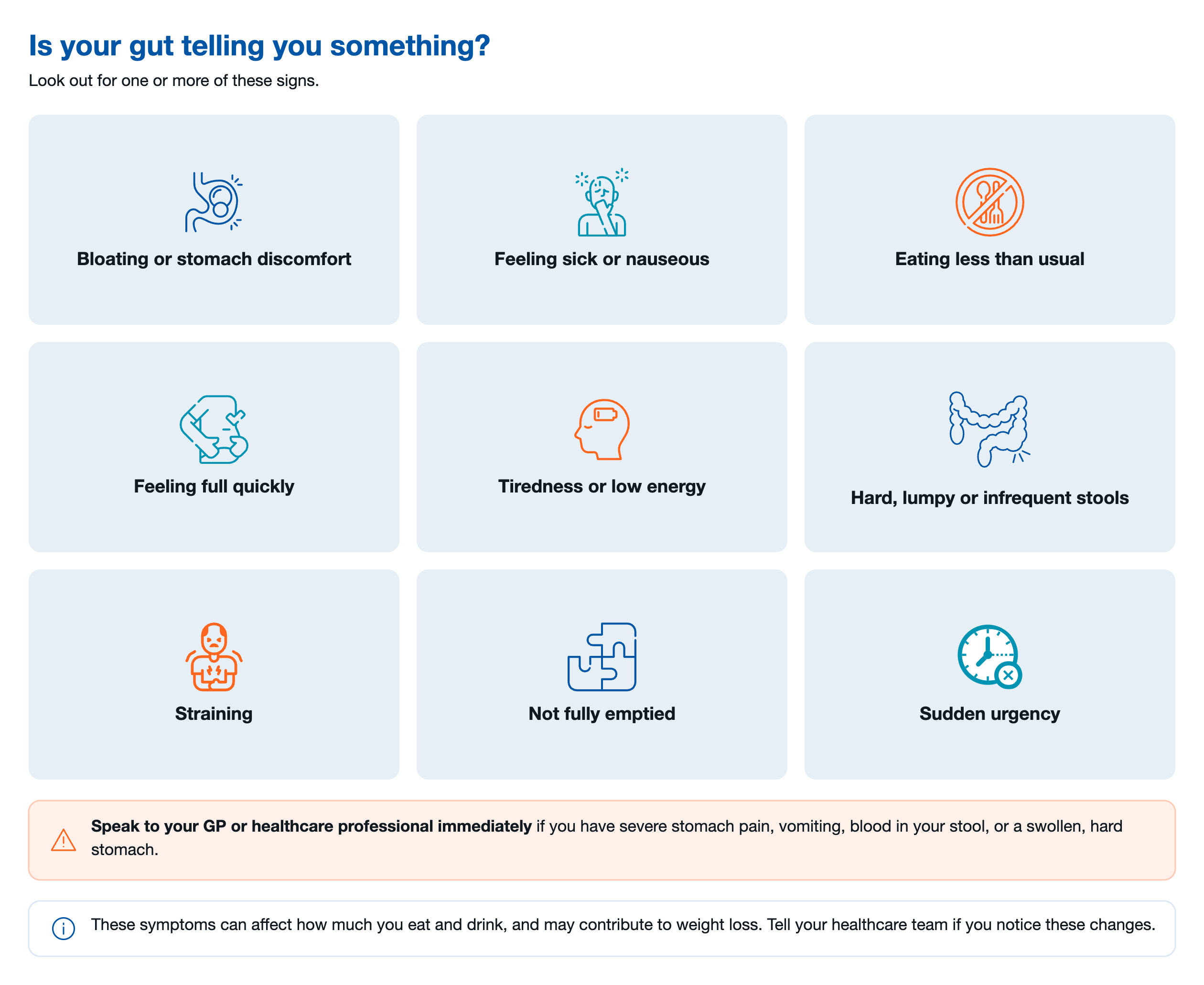
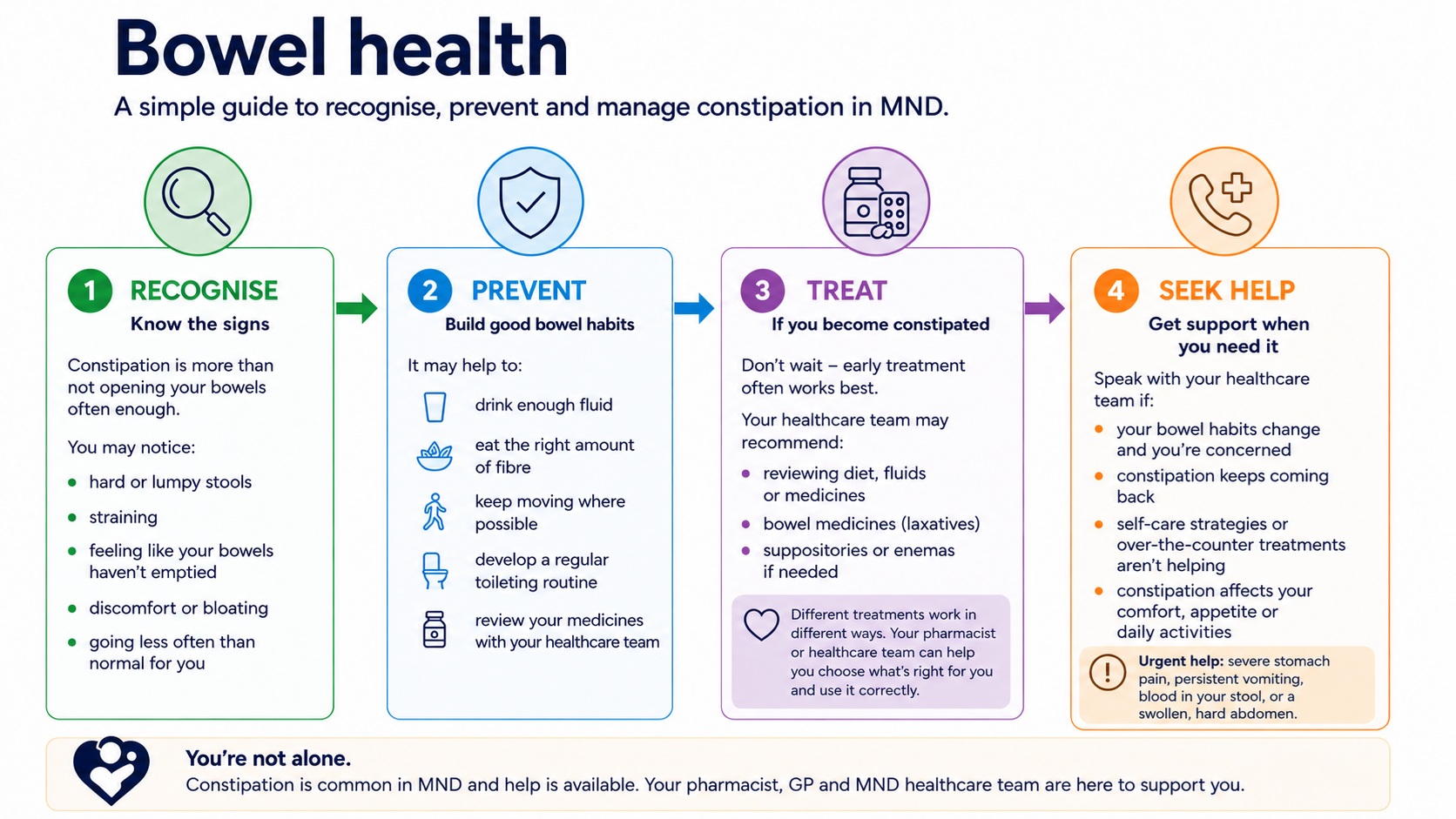
People often think constipation is about opening your bowels less often. It is more than that. You may be constipated if you:
pass hard or lumpy stools
need to strain
feel like your bowels haven't emptied completely
find it difficult to pass a bowel movement
open your bowels less often than is normal for you.
Even if you open your bowels every day, you may still be constipated if your bowel movements are difficult or uncomfortable to pass.
Paying attention to changes in your bowel routine can help you recognise constipation early.
Many people living with MND experience changes to their bowel habits.
MND can affect the nerves that control bowel movement, making it slower or harder for the bowel to work.
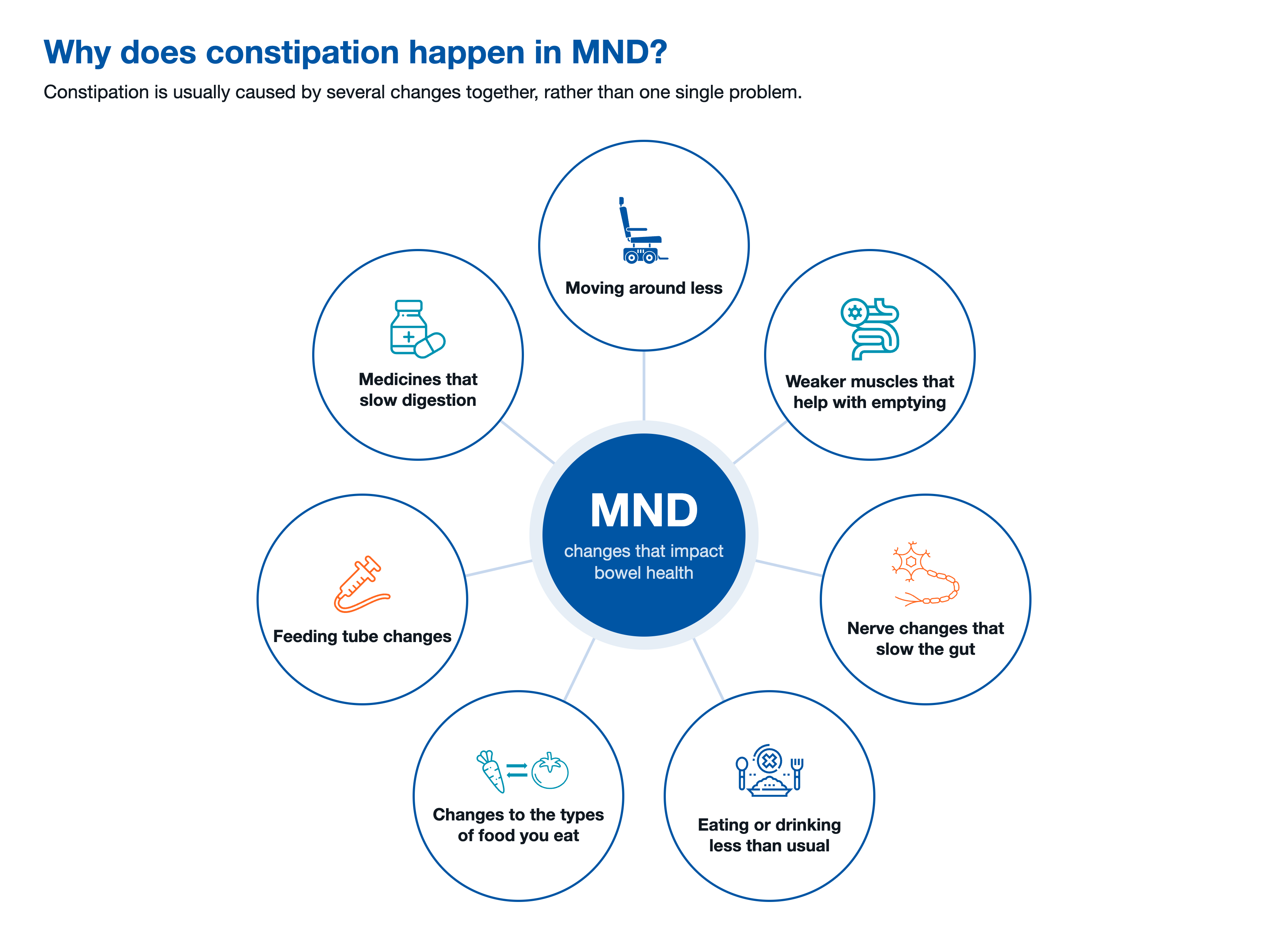
Constipation can happen at any stage of MND. It is usually caused by several changes rather than one single problem, including:
moving around less
weaker muscles that help empty your bowels
eating or drinking less than usual
changes to types of foods you are eating
medicines that can slow bowel movements
other health conditions
changes to food (nutrition) when using a feeding tube.
Having a new feeding tube may cause a change to bowel movements in the short-term. However, a feeding tube can also support taking in more fluid and/or fibre to help manage constipation. Monitor changes and discuss with your dietitian and healthcare team.
Constipation can affect your comfort, your energy and your quality of life.
You might notice:
bloating or stomach pain
feeling that you want to vomit (nausea)
you don’t want to eat and drink as much as you used to (reduced appetite)
feeling full quickly
feeling tired
These changes, particularly wanting to eat and drink less and feeling full quickly can affect how much you eat and drink. This may lead to weight loss.
Constipation can also affect how you feel emotionally. Some people:
avoid going out because they worry about using the toilet
feel embarrassed talking about bowel problems
become anxious or frustrated
need more support from family or carers.
If constipation is affecting your daily life, tell your healthcare team. They can help.
Establish a regular toilet routine
Going to the toilet at regular times can help train your bowels to empty more easily.
What you can do:
Try to use the toilet at the same time each day
Don’t ignore the feeling to open your bowels
Allow enough time so you don’t feel stressed or rushed.
“Allowing time to sit on the toilet and not feeling rushed can help reduce stress. Being more aware of how much you’re drinking to make sure you take in enough water regularly is also helpful.” Carer of person living with MND
Drinking enough fluid
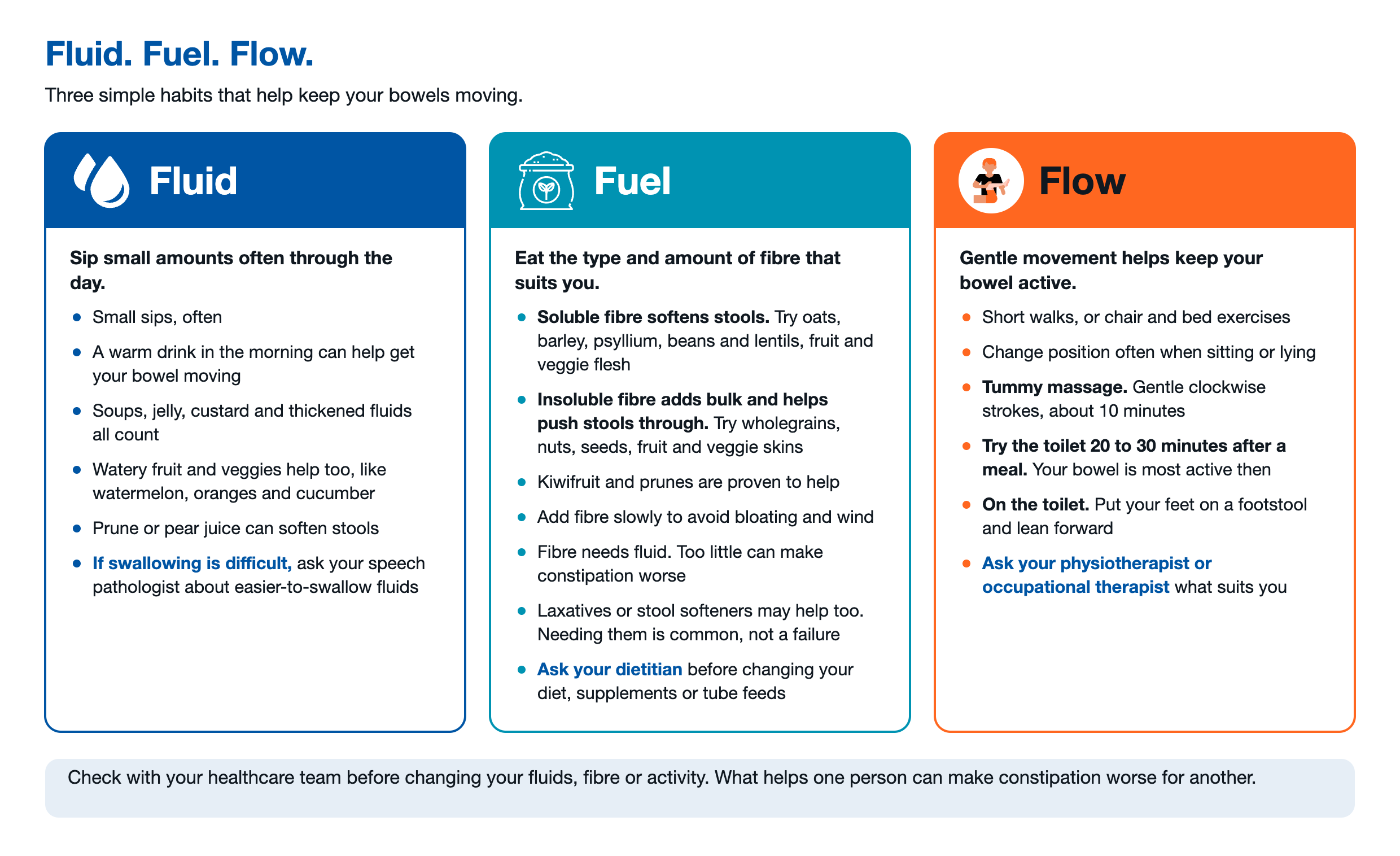
Drinking enough fluid helps keep stools soft and easier to pass. Not drinking enough can make constipation worse.
What you can do:
Sip water regularly throughout the day.
Drink the amount recommended by your healthcare team.
If swallowing has become difficult, ask your speech pathologist or dietitian about drinks or thickened fluids that are easier to swallow.
Eat the right amount of fibre
Fibre helps stools move through the bowel, but the amount that is right for you depends on how much you eat and drink. Too much fibre without enough fluid can make constipation worse.
What you can do:
Eat the amount and type of fibre recommended by your healthcare team.
Include high-fibre foods, such as wholegrains, fruits, vegetables, and beans - if they are suitable for you.

Talk with your dietitian about making changes to your diet and before taking fibre supplements.
“Using stool softeners and fibre supplements as required, and increasing fruit and vegetable intake as part of a pureed food diet can definitely help.” Carer of a person living with MND
Keep moving where possible
Movement helps keep your bowels active. Even gentle movement can help reduce constipation.
What you can do:
include gentle movement or exercise into your daily activities.
change your position often if you spend a lot of time sitting or lying down
ask your physiotherapist or healthcare team what activities are suitable.
Review your medicines
Some medicines can slow your bowels and contribute to constipation.
What you can do:
ask your pharmacist or doctor whether any of your medicines could be causing constipation.
tell your healthcare team if your bowel habits change after starting a new medicine.
don't stop taking prescribed medicines without speaking to your doctor or healthcare team first.
Some medicines and treatments may cause changes to your bowel patterns, including a shift from constipation to loose, watery stools or diarrhoea. Speak to your healthcare team for more information.
Speak with your healthcare team if:
you feel worried about your bowel habits
your bowel habits have changed
you haven't opened your bowels for several days and this isn't normal for you
constipation keeps coming back
constipation is affecting your eating, comfort or daily activities
you feel increasingly bloated or uncomfortable.
Seek urgent medical attention if you have:
three or more days without a bowel movement
severe stomach pain
vomiting
blood in your stool
a swollen or hard stomach
dizziness, or feeling light-headed or unwell as this could be a sign of dehydration.
You don't have to manage constipation on your own.
Your pharmacist can often be the first person to speak with. They can recommend suitable over-the-counter treatments, check whether your medicines may be contributing to constipation and advise when you should see your doctor.
Your healthcare team can help you find an approach that works for you.
Support may come from your:
pharmacist
GP
dietitian
speech pathologist
physiotherapist
nurse
MND clinic
MND Advisor
“As a carer, understanding what was going on and why, and how I could help my loved one made me feel better.” Former carer
If you think you are constipated, don't ignore it or hope it will go away on its own.
The right treatment depends on what is causing the constipation and how bad it is.
Your healthcare team may suggest:
changes to what you eat and drink
reviewing your medicines
bowel medicine that you take by mouth (laxatives)
medicine placed into the bottom/rectum (suppositories or enemas) to help empty the bowel, if constipation is very bad.
Treating constipation is different from preventing it.
Once constipation has improved, your healthcare team may recommend an ongoing bowel management plan to help prevent it returning.
“The relief of a bowel movement after being constipated for a length of time is understated. The bloating, a "too full" feeling and the discomfort disappear. Unfortunately, the cycle can begin again.” A person living with MND
You may find these questions helpful at your next appointment.
Could my medicines be making me constipated?
What can I do to help prevent constipation?
Am I drinking enough fluid?
Is what I’m eating (my diet) right for me?
Should I have a bowel management plan?
Which laxatives are suitable for me to treat or prevent constipation?
What should I do if constipation keeps coming back?
When should I seek urgent medical help?
How can my carer help me?
I find I’m in a cycle of constipation and then diarrhoea from the fibre supplements. What alternatives are there to break this cycle?
Is a natural solution or medication better?
If I do choose to use a laxative what timeframe are we looking at before a bowel movement happens?
You may find these infographic resources helpful:
You may also find these MND Australia resources helpful:
For advice based on your needs, speak with your GP, pharmacist, dietitian and/or your state MND Association.
Acknowledgements
Emily Farrugia (Northern Health/La Trobe University, Victoria), Emily Davison (Northern Health, Victoria), Alyssa Tomassini (Northern Health, Victoria), John Cameron (The Prince Charles Hospital/UQ, Queensland), Ingrid Swain (Barwon Health, Victoria), Elizabeth Kapur (PhD Candidate, Flinders University, Adelaide), Amber Sewell-Green (UQ Centre for MND Research, UQ/ RBWH/The Green Mind Co, Queensland) and other members of the Australian MND Dietitians Network; and Dr Barry Werth (University of Sydney), for their clinical review and guidance.
Peter Shack and members of the MND Lived Experience Network (LEN), whose insights ensure this resource reflects the needs and experiences of people living with MND.
Amber Rae Sewell-Green (UQ Centre for MND Research, UQ/ RBWH/The Green Mind Co, Queensland) for diagram creation.
DISCLAIMER: Dr Werth contributed to this document as an acknowledged reviewer and is also cited as a co-author of a referenced study (Werth et al., 2019).
Sources
Yamamoto Y, Fujita K, Yamazaki H, Haji S, Osaki Y, Izumi Y. (2024) Constipation in patients with motor neuron disease: A retrospective longitudinal study. Heliyon 10(6):e27951. https://pmc.ncbi.nlm.nih.gov/articles/PMC10957436
Aziz I, Whitehead WE, Palsson OS, Törnblom H, Simrén M. (2020). An approach to the diagnosis and management of Rome IV functional disorders of chronic constipation. Expert Review of Gastroenterology & Hepatology 14(1): 39–46. https://doi.org/10.1080/17474124.2020.1708718
Werth BL, Williams KA, Fisher MJ, Pont LG. (2019) Defining constipation to estimate its prevalence in the community: results from a national survey. BMC Gastroenterology 19:75. https://www.researchgate.net/publication/333257766